Solar Panel Planning Permission Rules in the UK
Last Updated: November 4, 2026
Quick Summary
Most UK homes can fit solar panels without a full planning application, because the work usually falls under permitted development rights. The solar panel planning permission rules in the in the UK differ slightly between England, Wales, Scotland and Northern Ireland, and flats, listed buildings and conservation areas face tighter controls.
Installations within the set size, height and projection limits usually need no planning application.
Listed buildings normally need listed building consent, and permitted development rights do not apply to the same extent.
Panels in conservation areas or National Parks may need a formal application, so check before installing.
Check whether an Article 4 direction covers your street, as it can remove permitted development rights.
Building regulations are separate from planning, so confirm who notifies building control.
Table of Contents
Do Solar Panels Need Planning Permission in the UK?
Most homes in the UK can have solar panels fitted without a full planning application, because the installation falls under permitted development rights, so the solar panel planning permission rules in the UK usually work in homeowners' favour.
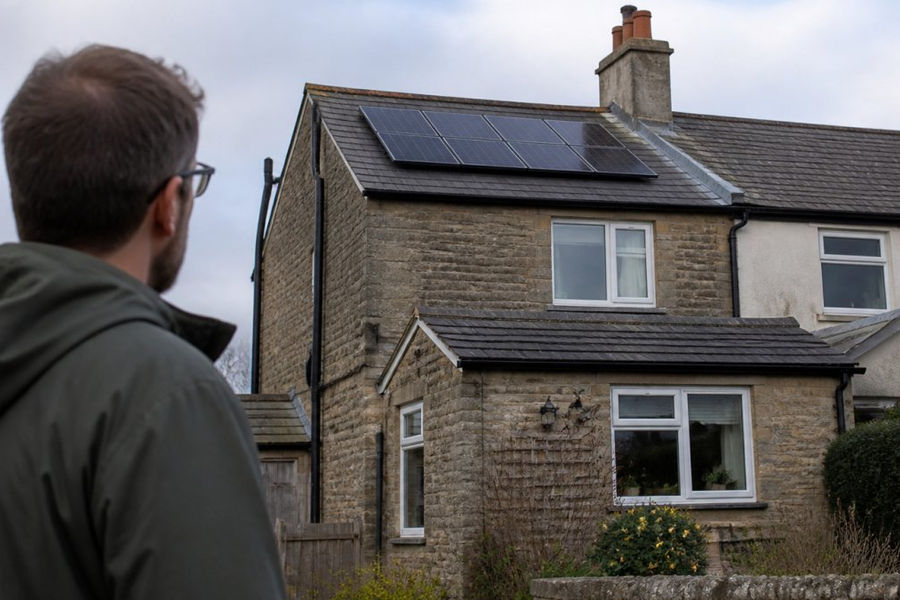
That said, permitted development is not a blanket exemption. Certain properties, such as flats, listed buildings and homes in designated areas, face tighter controls or require formal consent.
Solar installations also carry separate obligations. Building regulations govern electrical safety and structural integrity, and your installer should notify building control as part of the work.
If you are also planning an EV charger, the same property checks apply.
Permitted Development Rights for Solar Panels on Houses and Outbuildings
Permitted development allows householders to install solar equipment on a house or in its grounds without applying for planning permission, provided the work meets specific conditions. These rights are set out in Planning Portal guidance on permitted development for householders.
Sunsave
The rules cover both the main dwelling and outbuildings within the property boundary. Outbuildings such as garages, sheds and garden offices can carry solar panels under the same general principles, though the limits on size and position still apply.
A common mistake is assuming that a panel installed on a garage roof is treated differently from one on the house.
Roof-Mounted Panels: Size, Height and Projection Limits
For roof-mounted panels, the key limits are the height of the panels relative to the existing roof and how far they project from the roof plane.
The total area of solar equipment is also limited. Standalone equipment in the grounds has a separate cap, and roof-mounted arrays should be measured against the relevant limit before installation. Your installer should provide dimensions for each panel and the array layout so you can check compliance yourself.
A practical tip: ask the installer to confirm the projection measurement on the drawing, not just in conversation. Projection is the dimension most often exceeded when mounting frames are fitted with generous spacing.
Ground-Mounted Panels: Size and Location Restrictions
Ground-mounted panels are subject to stricter limits than roof-mounted ones. Free-standing equipment within the garden is generally permitted only where it stays below a set height and is not sited forward of the principal elevation of the house.
Location matters as much as size. Ground-mounted equipment must not sit within the curtilage in a way that adversely affects the appearance of the property or the surrounding area.
Because the thresholds are specific, verify the current figures in the relevant order for your nation rather than relying on a summary. If your plan approaches any limit, a pre-application enquiry to your local planning authority can save time later.
Solar Panels on Listed Buildings: What Consent Is Required
Listed buildings are subject to a different regime. Permitted development rights do not apply to the same extent, and installing solar panels on a listed building or within its curtilage will normally require listed building consent as well as, in some cases, planning permission.
The main concern is visual and physical impact. Panels fixed to historic roofs can damage original fabric, and visible arrays can alter the character of the building.
Alternatives such as roof-integrated systems or installations on a less visible elevation may improve the chances of approval.
Solar Panels in Conservation Areas and Designated Land
Conservation areas and other designated land, including National Parks, Areas of Outstanding Natural Beauty and World Heritage Sites, carry extra controls (Permitted Development Rights - Planning Permission). In many cases, permitted development rights for solar panels are restricted, meaning that works which would otherwise be allowed on an unlisted house elsewhere may need a formal application.
An Article 4 direction can also remove permitted development rights in a specific area (When are permitted development rights removed?). Where one is in force, the usual freedoms to fit panels on a visible roof slope may no longer apply. Check with your council whether your street is covered, because a direction can apply even where the wider area is not designated.
If your property is in a conservation area, the most practical step is to review the council's conservation area appraisal. It sets out what the authority considers important and helps you design an installation that is more likely to be approved.
How Planning Rules Differ Across England, Wales, Scotland and Northern Ireland
Planning is a devolved matter, so the permitted development framework that applies to solar panels depends on where the property sits.
Nation | Governing permitted development instrument | Where the rules are administered |
England | Town and Country Planning (General Permitted Development) (England) Order 2015, as amended | Local planning authority; guidance on the Planning Portal |
Wales | Town and Country Planning (General Permitted Development) (Wales) Order 2016 | Local planning authority; guidance published by the Welsh Government |
Scotland | Town and Country Planning (General Permitted Development) (Scotland) Order 1992, as amended | Local planning authority; guidance published by the Scottish Government |
Northern Ireland | Planning (General Permitted Development) Order (Northern Ireland) 2015 | Department for Infrastructure; guidance on the Planning NI portal |
England is the most permissive baseline for householders.
Scotland operates under its own planning framework, and the Scottish Government publishes householder guidance. That guidance, not English planning portals, should be treated as controlling for a Scottish property.
Northern Ireland operates under a separate planning system, so homeowners there should check the position with the relevant planning authority.
Watch out: terminology differs as well as thresholds.
The practical implication is straightforward: identify the nation first, then read that nation's order and that nation's published householder guidance.
Checking Restrictions and Applying Before You Install Your Panels
Before committing to an installation, work through the solar panel planning permission rules in the UK in the order below.
1. Confirm the planning history of the property. Your local planning authority's online planning register lets you search by address.
**2.
3. Measure against the limits. Take the panel dimensions, the projection from the roof plane and the height relative to the roof, and check them against the order for your nation.
4. Confirm building regulations separately. Building regulations are a distinct regime from planning. Electrical and structural work must comply with the applicable building regulations.
**5.
If you need to apply for planning permission
Where the installation falls outside permitted development, you will need a householder application (or a full application for larger or non-domestic schemes). In England, applications are submitted through the Planning Portal and validated by the local planning authority.
Fees are payable to the local authority and the current householder fee should be checked with the authority before submission, as it is updated periodically. Scotland, Wales and Northern Ireland each set their own fee scales and validation lists.
Watch out: submitting an incomplete application does not stop the clock. Validation only begins once the authority has everything on its list, so missing drawings can add weeks before the eight-week period even starts.
Enforcement and retrospective consent
If panels are installed without permission where permission was required, the local planning authority can take enforcement action. Where development has occurred without permission, the local planning authority can take enforcement action, and there is generally a right of appeal.
Where an installation has already been made, a retrospective application can regularise it, and a lawful development certificate can confirm lawfulness where permitted development did apply. Neither route cures a breach of building regulations, which are dealt with separately.
Once the planning position is clear, the electrical side of the project follows. Once installed, our charger maintenance service can keep the system safe and performing well.
Frequently Asked Questions
Do solar panels need planning permission?
Most solar panels on houses in England, Wales, Scotland and Northern Ireland fall under permitted development and do not need a full planning application, provided they meet set conditions. Roof-mounted panels are subject to conditions on projection and height. Listed buildings, conservation areas and some flats fall outside these rights. Check the conditions with your local planning authority before you book an installation, as the rules differ slightly between nations.
Can I install solar panels on a listed building?
Yes, but in almost every case you will need listed building consent before work starts, because the panels affect the building's character. Permitted development rights do not apply to listed buildings, so consent should be obtained before installing. Applications are made to your local planning authority and are judged on how visible the panels are and whether they can be fitted without damaging historic fabric. Ask a heritage specialist or the planning officer for early advice before you commission an installer.
Do solar panels need planning permission in a conservation area?
In most conservation areas, permitted development rights are restricted rather than removed. Panels on a house may still be allowed, but any panel on a roof slope fronting a highway, or on a building within the curtilage, may need a planning application. Some councils use an Article 4 direction to remove permitted development rights in specific streets, which means you will need consent even for small roof-mounted systems. Confirm whether your property sits in a conservation area or is covered by an Article 4 direction using your council's online planning map before you proceed.
Do I need planning permission for ground-mounted solar panels?
Ground-mounted panels can often be installed under permitted development if they meet the conditions for householders, which should be checked before installation. Larger or taller arrays, or systems in front of a principal elevation, generally need a planning application. Installations on designated land, including World Heritage Sites and areas of outstanding natural beauty, have stricter limits. Measure the proposed footprint and height against the current General Permitted Development Order before ordering the system.
What building regulations apply to solar panels?
Planning permission and building regulations are separate consents. Building regulations in England and Wales, and the equivalent building standards in Scotland and Northern Ireland, cover structural safety, electrical safety and fire safety of the roof and wiring, but in most domestic cases a competent person scheme registered installer can self-certify the work, so no separate building control application is needed. Electrical installations must also meet the applicable wiring regulations. Ask your installer for an electrical installation certificate and confirmation of building regulation compliance at handover.
How do I apply for planning permission for solar panels?
Submit an application through your local planning authority's online planning portal, usually with a location plan, site plan, elevation drawings showing the panels, and a short design and access statement. Householder applications attract a fee set by the relevant authority, and the current fee should be checked before submission. Allow extra time if the property is listed or in a conservation area, because a heritage statement may be required. Your installer can usually prepare the drawings, but check the scheme details before you submit.
Can permitted development rights for solar panels be restricted?
Yes. Permitted development rights can be removed by an Article 4 direction made by the local planning authority, or by conditions attached to an earlier planning permission for the property. Restrictions can also apply automatically to listed buildings, scheduled monuments and certain designated areas. Leasehold flats and shared buildings may be subject to lease terms or freeholder consent even where planning permission is not required, so check your title deeds and speak to your managing agent before installing.
Do solar panel planning rules differ across the UK?
Yes. Planning is a devolved matter, so England, Wales, Scotland and Northern Ireland each have their own rules, even though the broad approach to permitted development is similar. Scotland and Northern Ireland use different planning legislation and terminology, and Wales operates under its own planning framework. Always check the rules for the nation where the property is located, using the relevant government or planning authority website, rather than relying on guidance written for England alone.

Comments