Can You Charge an Electric Car From an Outdoor Socket?
Last Updated: 12 November 2026
Quick Summary
Yes, you can charge an electric car from a standard outdoor socket, but it is slow and not always safe. A three-pin plug delivers around 2.3 kW, so a full charge can take many hours. Only use it if the socket and wiring are in good condition.
A standard socket delivers around 2.3 kW, far less than a dedicated charger.
A 60 kWh battery takes roughly 26-27 hours to fully charge from a three-pin plug.
Check the socket, cover and plug for damage or looseness before every charge.
Confirm the circuit has an RCD that trips when its test button is pressed.
Avoid extension leads and circuits shared with heavy appliances during long charges.
Is your outdoor socket safe for EV charging?
Yorks EV installs professional home chargers across Yorkshire, completed within 14 days.
Table of Contents
Can You Charge an Electric Car From a Standard Outdoor Socket?
Yes, you can charge an electric car from a standard outdoor socket, but it is slow and it is not always safe. The answer depends on the socket, the wiring behind it and how you use it.
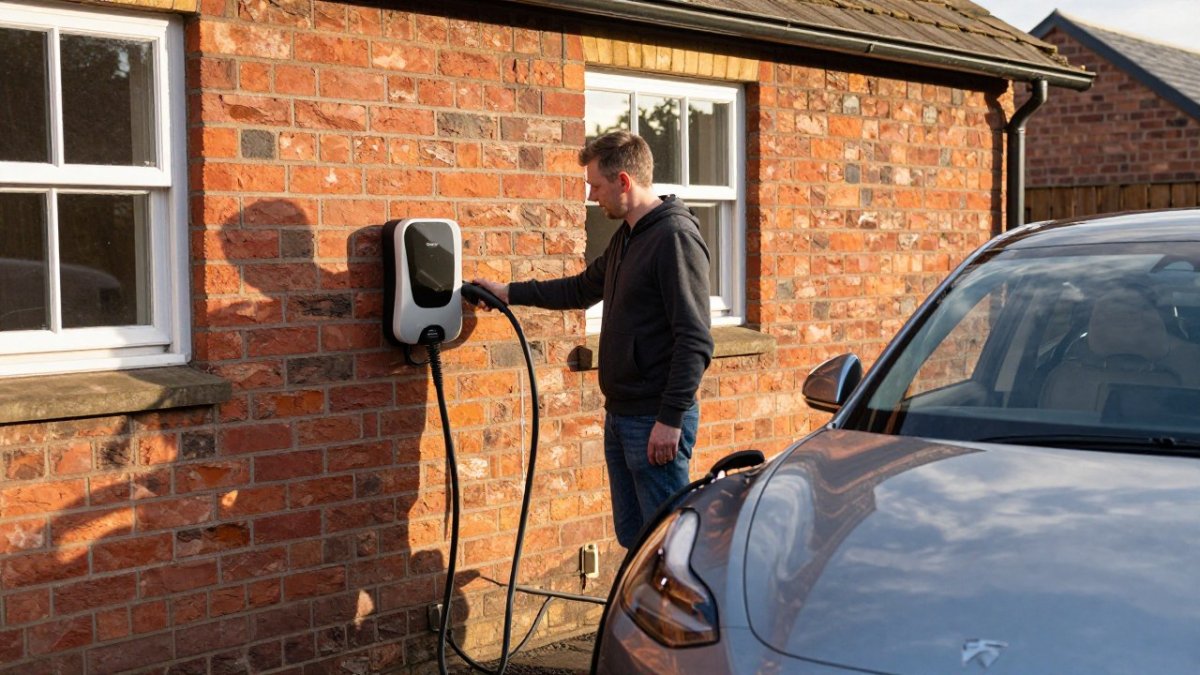
A standard UK socket is a 13-amp, three-pin socket. Most EVs can draw power from it through a supplied mains cable. The car takes what the socket can give, so the charge is much slower than a dedicated charger.
A standard socket is limited in the power it can deliver.
A dedicated home charger delivers considerably more power.
Charging speed depends on your car's battery size and efficiency.
Watch out: An outdoor socket that is damp, old or overloaded can overheat during a long charge. Check it before you plug in.
Is It Safe to Charge an Electric Car From a Normal Socket?
It can be, but only when the socket and wiring are in good condition. A standard socket was never designed for hours of continuous load. Charging draws steady current for many hours, which puts stress on plugs, sockets and cables.
Many electricians advise against regular use of an ordinary socket for EV charging. The main risks are:
Overheating at the plug or socket
Damage from water or damp
Loose connections that create heat
Overloaded circuits shared with other appliances
If you do use an outdoor socket, use a cable and plug in good condition, and avoid extension leads. Keep the socket covered when it is not in use. Weatherproofing an outdoor charging point explains how to protect it properly from the weather.
How Long to Charge an Electric Car From a 3-Pin Plug
Charging from a three-pin plug is slow because the socket limits you to around 2.3 kW. The table below shows roughly how long a full charge takes for common battery sizes, assuming the battery starts empty and the car accepts the full 2.3 kW throughout.
Battery capacity | Approximate full-charge time at 2.3 kW |
40 kWh | About 18-19 hours |
50 kWh | About 22-23 hours |
60 kWh | About 26-27 hours |
75 kWh | About 33-34 hours |
90 kWh | About 39-40 hours |
These figures are estimates. Real times are usually a little longer because of charging losses and because the car tapers the charge rate as the battery fills. A common pattern is for the last 10-20% of capacity to take disproportionately longer.
Turning Power Into Range
Time on its own is not very useful. What matters is how much range you add. To estimate that, you need the car's efficiency in miles per kilowatt-hour (mi/kWh). A rough guide:
Multiply the energy delivered by the efficiency figure to estimate the range added. Your car's manufacturer documentation will give its efficiency.
How to Calculate the Cost
The cost of a charge is the energy delivered multiplied by your unit rate. The formula is:
Cost = battery capacity (kWh) × unit rate (pence per kWh) ÷ 100
Use your own unit rate from your electricity bill, because rates vary by tariff and region.
Watch out: A long charge on a standard socket can push the socket, plug and cable to their limits. If the plug or socket feels hot to the touch during charging, stop, unplug and have the circuit checked before using it again.
Step-by-Step: Checking an Existing Outdoor Socket Before You Charge
Before you plug in, treat the socket as a piece of equipment that has to pass a test, not just a hole in the wall. Work through the checks below in order. If any check fails, stop and do not charge until it has been put right.

Inspect the socket face and housing. Look for cracks, scorch marks, brown discolouration or a softened or distorted faceplate. These are signs of past overheating and mean the socket should be replaced, not reused.
Check the weatherproof cover and seal. The cover should close fully and the gasket should be intact and flexible, not perished or split. A cover that flaps open or no longer seals lets water reach live parts.
Test the plug fit. Insert the plug and check that it seats firmly with no wobble. A loose fit creates resistance and heat at the pins, which is one of the most common causes of a melted plug.
Confirm RCD protection. The circuit should be protected by a residual current device (RCD), either at the consumer unit or as part of the outdoor socket itself. Press the test button and confirm it trips (RCDs put to the test). If it does not trip, the protection is not working.
Check what else is on the circuit. A socket on a circuit shared with a tumble dryer, immersion heater or garden machinery is a poor choice for a multi-hour charge. Identify the circuit at the consumer unit and avoid charging when other heavy loads are running.
Look at the cable route. The charging cable should run without being trapped in doors or windows, without being walked over, and without being pulled tight. Check the full length for cuts, abrasion or exposed inner cores.
Confirm earthing. The socket must be properly earthed. You cannot confirm this by eye; it needs a test with an earth loop impedance or RCD tester.
Watch out: A socket that looks fine from the outside can still have loose terminals or degraded wiring behind the faceplate. Visual checks are not a substitute for testing.
When to Call an Electrician
Call a qualified electrician before charging if any of the following apply:
The socket is more than a few years old and has never been inspected.
The RCD does not trip when tested, or you cannot find an RCD at all.
The socket is on a circuit you cannot identify or that is shared with heavy appliances.
There is any sign of heat damage, a burning smell, or a plug that feels warm after a short period.
The socket is fed by a spur or an extension of unknown cable size.
The outdoor socket was installed before you moved in and you have no paperwork for it.
An electrician will check cable size, circuit protection, earthing and the condition of the terminals, and can tell you whether the socket is suitable for a continuous load or should be replaced with a dedicated charging point.
Inspection Checklist for Outdoor Sockets
Use this checklist before you start charging:
The socket shows no cracks, scorching or melting
The weatherproof cover fits and seals well
The plug fits firmly with no looseness
The socket is not wet or sitting in standing water
An RCD protects the circuit and trips when tested
The circuit is not shared with heavy appliances
The cable is undamaged along its full length
No extension lead is used
The cable is not trapped, stretched or run across a walkway
The socket has been tested by an electrician if its history is unknown
Home EV Charger vs 3-Pin Plug: Which Is Right for You?
A dedicated home charger is faster, safer and built for regular use. A three-pin plug suits occasional top-ups or emergencies.
3-pin plug: Low cost, slow, best for occasional use
Home charger: Faster, designed for daily charging, safer for regular use
If you charge most nights, a dedicated charger is usually the better choice.
Outdoor Socket Installation for EV Charging: When a Dedicated Point Makes Sense
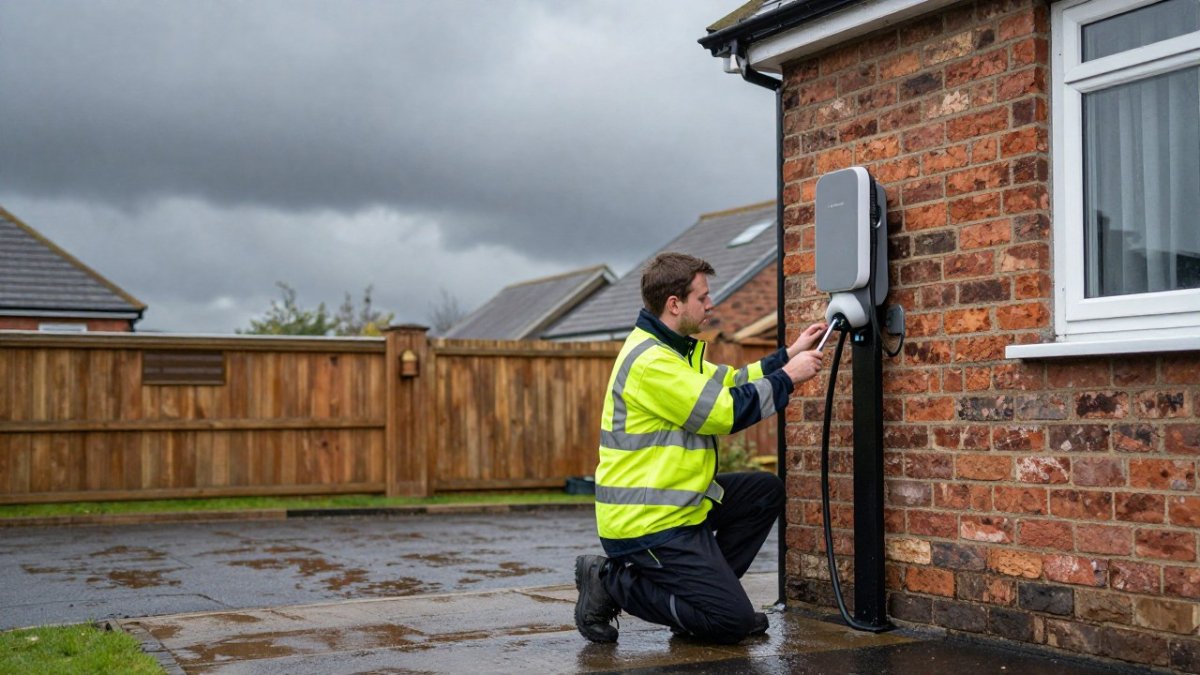
A dedicated outdoor point makes sense when you charge often or drive a larger battery. It gives you a properly rated circuit and a weatherproof unit built for the job.
A qualified installer can check your consumer unit and cable size before fitting a new point. Get a professional opinion before you decide on the wiring.
Booking a Safe Home Charger Installation in Yorkshire With Yorks EV
At Yorks EV, we supply and install domestic EV chargers. Our team are highly qualified, time-served, UK-trained electricians. Installations are completed within 14 days, and there is no travelling charge across North, South, East and West Yorkshire. Our standard package includes all materials, labour and VAT.
If you are ready to move away from slow charging, get a quote from Yorks EV to see what a dedicated home charger would cost for your home. You can also book a home charger installation with our team.
Need a safe charging point at home? Yorks EV installs reliable home EV chargers across Yorkshire. Get a quote and start charging with confidence.
Frequently Asked Questions
Can you leave an electric car plugged into a standard socket overnight?
You can, but it is not recommended on a standard three-pin socket for long periods. Charging for many hours at 10 amps draws a sustained load that can overheat plugs, sockets and wiring that were never designed for continuous use. If you must charge this way, make sure the socket is in good condition, not overloaded by other appliances, and ideally on its own circuit. A dedicated home charger installed by a qualified electrician is the safer option for regular overnight charging.
Do you need a special outdoor socket to charge an electric car?
No special socket type is required for a standard three-pin connection, but the socket must be suitable. It should be weatherproof, in good condition, correctly wired and protected by an appropriate circuit. Many older outdoor sockets are not up to continuous loads. Having a qualified electrician check the socket and circuit before regular charging is the most reliable way to confirm it is safe to use.
Can an extension lead be used to charge an electric car outdoors?
An extension lead is best avoided for charging an electric car. Leads are often rated for short, intermittent use rather than hours of continuous current, and joints or coiled cable can heat up. If a lead is unavoidable, it should be fully unwound, rated appropriately and kept clear of rain and standing water. Using a fixed socket with a dedicated home charger removes this risk entirely.
Is a dedicated home EV charger better than a standard socket?
For regular charging, a dedicated home charger is generally the better choice. It is designed for sustained loads and is installed by a qualified electrician. It also charges more quickly than a three-pin plug. Yorks EV supplies and installs domestic EV chargers across Yorkshire, and you can get a quote through the Yorks EV website to compare the options for your property.

Comments