How to Weatherproof Outdoor EV Charging Stations
Last Updated: November 7, 2026
Quick Summary
Weatherproofing outdoor EV charging stations means keeping water out, letting condensation drain away and ensuring protective devices work. Choose an IP rating to suit the location, mount the unit 1 to 1.5 metres above ground with a drip loop, and inspect seals, cable and drainage every few months.
Mount the charger roughly 1 to 1.5 metres above ground so splashing from the driveway cannot reach it.
IP55 suits exposed walls and coastal spots, while IP44 is adequate under a porch or deep overhang.
Fit a drip loop at the cable entry so water runs off before it reaches the gland.
Switch off at the consumer unit and check door and gland seals every few months.
Stop using the charger if the RCD trips repeatedly in wet weather or water is found inside the enclosure.
Is your outdoor charger ready for winter?
Yorks Ev supplies and fits weatherproof home EV chargers across Yorkshire with fixed-price quotes.
Table of Contents
Why Weatherproofing Outdoor EV Charging Stations Matters
Water and electricity are a poor pair. A charger that lets moisture into the wrong place can trip its protective device, corrode its pins or fail outright.
So the goal is simple: keep water out, let any condensation drain away, and make sure the protective devices do their job.
Below, we walk through IP ratings, mounting, enclosures, cable care and a maintenance routine you can follow yourself.
EV Charger IP Rating Explained: Reading the Numbers
An IP rating is a two-digit code that states how well an enclosure keeps out solid objects and water. The first digit covers dust and fingers; the second covers water. Higher is better, but higher is not automatically the right choice.
IP44: protected against splashing water from any direction. Adequate under a porch or deep overhang.
IP54: protected against dust in harmful amounts and splashing water. A sensible baseline for sheltered outdoor walls.
IP55: protected against dust and low-pressure water jets. A sound pick for exposed walls and coastal spots.
What the Two Digits Actually Test
The first digit runs from 0 to 6. It is about solids: 4 means protection against tools and wires thicker than 1 mm; 5 means dust-protected (some dust may enter but not in harmful amounts); 6 means dust-tight.
Read the second digit as a description of test conditions, not a promise for your driveway. A jet test does not simulate years of wind-driven rain at a wall corner.
What IP Ratings Do Not Guarantee
An IP rating is a laboratory result on a sample, not a lifetime warranty. It does not cover:
Ageing seals, rubber hardens and shrinks over years of sun and frost.
Installation quality, a correctly rated unit with a poorly sealed cable gland will let water in.
Orientation, a unit rated for jets may still trap water if mounted with its cable entry facing upwards.
Installation detail, gland sealing, cable drip loops, mounting height and drainage, is an important factor alongside the IP rating.
Matching the Rating to the Location
Use the rating as one input among several. A sheltered location under an eave lets you work with a lower IP rating.
When comparing chargers, check that the rating applies to the whole unit as installed, including the cable entry and connector holster, not just the main enclosure.
The second digit of an IP rating describes the water test conditions the enclosure has passed.
IP rating | Water protection | Best suited to |
IP44 | Splashing water from any direction | Under a porch or deep overhang |
IP54 | Splashing water, dust in harmful amounts | Sheltered outdoor walls |
IP55 | Low-pressure water jets | Exposed walls and coastal spots |
IP65 and above | Dust-tight and jet-resistant | Where the unit faces driving rain |
Planning Your Outdoor EV Charger Installation
Good outdoor EV charger installation starts before anyone drills a hole. Walk the route from your consumer unit to the proposed charger position and note what the weather will do to it.
Ask three questions:
Which way does the prevailing wind and rain hit this wall?
Is there an overhang, porch or garage return to shelter the unit?
Where does water collect on the ground beneath it?
A sheltered location under an eave lets you work with a lower IP rating. An exposed location on a gable end facing the weather calls for a higher one and careful sealing.
Mounting Height and Drainage
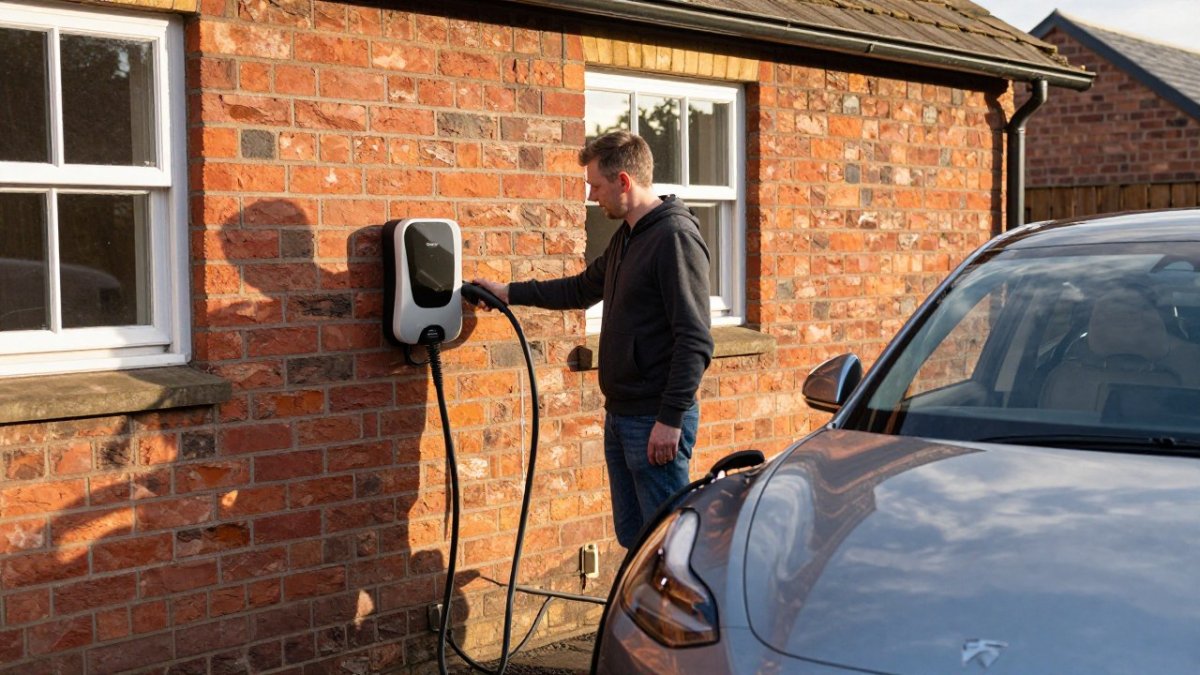
Mount the charger roughly 1 to 1.5 metres above ground, at a height that suits the cable and the car's inlet. Too low, and splashing from the driveway reaches it. Too high, and the cable strains at the connector.
Check drainage next. Water pooling at the base of the wall will find any gap in a cable gland. A simple gravel strip or a slight fall away from the wall keeps the base dry.

Do You Need a Weatherproof EV Charger Enclosure?
A weatherproof EV charger enclosure is a cover or housing fitted around the unit to shield it from rain and sun.
Many quality chargers already carry a suitable IP rating for outdoor use.
Watch out: a poorly ventilated cover can trap moisture and make condensation worse. Choose one designed for the charger model, with drainage, rather than a generic box.
Best for: exposed walls, coastal spots, units under a leaking gutter.
Skip if: the charger sits under a deep porch and already carries IP55 or better.
Protecting the Charging Cable, Connector and Outdoor Socket
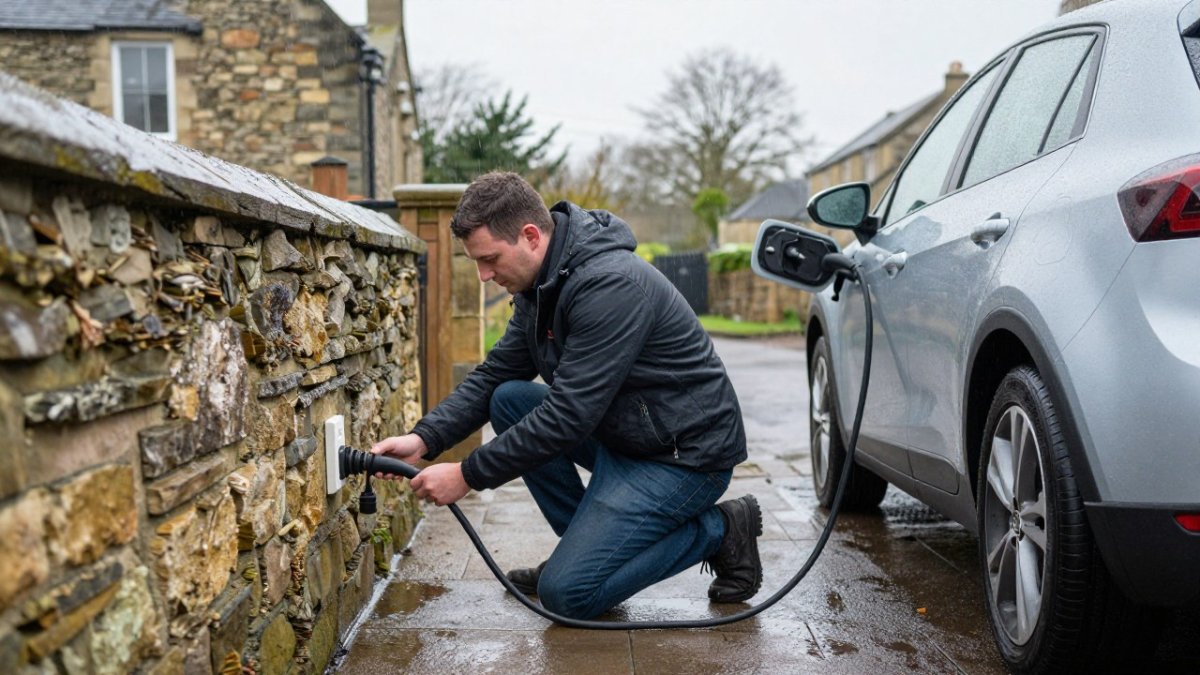
The charging cable and connector take more abuse than the charger itself. They get dragged across gravel, coiled wet, and left hanging in the rain.
A few habits make a real difference:
Hang the cable on a hook so the connector never rests on the ground.
Wipe the connector dry before plugging in after heavy rain.
Check the cable sheath for cracks or scuffs each month.
Long-term charging from a domestic socket is generally best avoided; a dedicated unit is typically safer and faster.
For a full routine on keeping the cable tidy and dry, see our guide on safe EV charging cable management at home.
Electrical Safety: Circuit Breakers, Earthing and Qualified Installation
Electrical safety for an outdoor charger rests on three things: a dedicated circuit, the right protective device, and proper earthing. Get any of them wrong and the weather is the least of your problems.
The charger should run on its own circuit from the consumer unit, protected by a circuit breaker and, where required, an RCD.
This work is not a DIY job. It needs a qualified electrician who can test the circuit and certify it.
If you are unsure what to look for, our article on electrician qualifications for home chargers sets out the checks.
Regulations and standards change, so confirm current requirements with your installer or the official guidance before work begins.
EV Charger Maintenance: A Step-by-Step Inspection Routine
A short inspection every few months catches most weather damage early. Set aside ten minutes and work through this list.
Switch off the charger at the consumer unit before touching anything.
Check the seals around the door and cable gland for cracks or gaps.
Look for water marks or rust inside the enclosure.
Inspect the cable for scuffs, and the connector pins for corrosion.
Clear the drainage path at the base of the wall.
Test the RCD using its test button.
Note any fault codes and book a service if they recur.
If anything looks worn, call a professional rather than patching it. Our charger maintenance service covers a full inspection and service.
A Seasonal Weatherproofing Checklist
Weather damage follows the seasons. A routine timed to the calendar catches problems before they bite.
Before winter (late autumn)
Check door and gland seals for hardening or cracks; replace if in doubt.
Confirm the cable entry has a drip loop so water runs off before reaching the gland.
Clear gutters and downpipes that discharge near the charger.
Test the RCD and note the trip time if your unit displays it.
After winter (early spring)
Look for water staining, rust or white corrosion deposits inside the enclosure and on pins.
Inspect the cable sheath for frost cracks, especially where it coils.
Clear any silt or debris from the drainage path at the base.
Re-check gland tightness; frost can loosen compression fittings.
Before summer
Check ventilation and shade; a unit in direct sun can derate or trip on thermal protection.
Look for insect nests or debris in any vent or drainage path.
After summer
Inspect for UV damage: chalky plastic, brittle cable sheath, faded labels.
Check that seals have not dried out and shrunk.
Warning Signs That Mean Stop Using the Charger
Some faults are a nuisance; others are a safety issue. Stop using the charger and arrange an inspection if you see:
Repeated RCD or circuit-breaker trips when charging, especially in wet weather.
Error lights or fault codes that recur after a reset.
A wet connector or socket, do not plug in; dry it and have the unit checked.
Visible damage to the cable sheath, pins or enclosure.
Do not open the charger to investigate. Moisture-related faults often involve protective devices and earthing, and those need test equipment and a competent person.
Snow, Frost, Coastal Salt Air and Standing Water
Snow and frost bring their own risks. Do not yank a frozen cable; let it thaw.
Coastal salt air speeds up corrosion on pins and fixings. Rinse and dry the connector more often if you live near the coast.
Standing water is the clearest warning sign. If your charger sits in a spot that floods, raise the mounting height or move it.
Booking Your Weatherproof Charger Installation
Getting the weatherproofing right is far easier when the installation is done properly from the start.
At Yorks EV, our time-served, UK-trained electricians fit domestic chargers.
If you are ready to move forward, you can arrange your charger installation or get a quote for a fixed price before you commit.
A charger that faces the weather unprotected will eventually let you down.
Yorks Ev can take care of the installation and the checks, so your charger stays ready whatever the sky does.
Frequently Asked Questions
Can an EV charger be installed outside?
Yes. An outdoor EV charger installation is standard practice, provided the unit carries a suitable IP rating, is mounted under cover where possible, and is wired by a qualified electrician. A wall-mounted charger fixed to an external wall with the cable routed safely is normal. The deciding factors are the IP rating, drainage around the mounting point, and whether the charger is in an exposed or sheltered location. If your mounting spot faces driving rain or sits near ground level, a weatherproof EV charger enclosure adds a useful extra layer of protection.
What IP rating should an outdoor EV charger have?
Look for at least IP54 for a sheltered outdoor wall, and IP55 or higher for an exposed location. The first digit rates protection against solids such as dust, the second against water. IP44 is the minimum many outdoor sockets meet but is best kept under cover. A charger rated IP65 or IP66 handles jets of water and heavy rain with more margin. An EV charger IP rating explained properly is about matching the number to where the unit sits, not buying the highest number available.
Can you charge an electric car in the rain?
Yes. Charging in rain is safe when the charger, cable and connector are intact and correctly rated. The connector pins sit recessed and the handshake between car and charger only starts once a secure connection is made. The risks come from damage, not rain itself: cracked seals, a worn connector, or water sitting in an outdoor socket. Inspect the connector for moisture or corrosion before plugging in, and never force a damp plug into the car. If you see water inside the connector or the charger trips, stop and get it checked.
How often should an outdoor EV charger be checked?
Run a visual check monthly and a deeper inspection twice a year, plus after any storm or freeze. Monthly: look for cracks in the casing, wear on the cable, and moisture in the connector. Twice yearly: check the seals, cable gland and mounting fixings, and clear any debris or standing water around the base. Book a professional EV charger maintenance check if the unit trips repeatedly, the casing is damaged, or you notice corrosion. Coastal salt air and heavy frost make more frequent checks worthwhile.

Comments