Future Proofing Home Electric Vehicle Charging
Last Updated: November 1, 2026
Quick Summary
Future proofing home electric vehicle charging means installing conduit, cable routes and capacity now that can handle a second charger, a bigger car or a smarter tariff later. Plan for at least one spare way in the consumer unit, a draw cord in every conduit run and a route that reaches a second parking space.
A 7.4kW charger draws roughly 32 amps on a single phase, so check your main fuse rating first.
Work through options cheapest first: load-managed charger, consumer unit upgrade, then DNO supply upgrade.
Specify conduit large enough for a second cable; 25mm is a common minimum for one 6mm² or 10mm² cable.
Leave a lockable isolator local to the charging point for safe maintenance isolation.
Tell your installer a second charger is likely so they can size the supply and route conduit accordingly.
Table of Contents
Why Future Proofing Your Home EV Charging Matters
Future proofing home electric vehicle charging is the practice of installing infrastructure today that can handle tomorrow's vehicles, second chargers and smarter energy tariffs without ripping walls open again. This guide covers the decisions that matter most before an electrician arrives.
The case for planning ahead is straightforward. A basic install sized only for today's car often becomes the expensive one, because upgrading a supply, re-running cable or adding a second point later costs more than doing it once, properly.
Below, we'll show you exactly how to plan capacity, cable routes and controls so your setup keeps pace with your household.
Assessing Your EV Charger Electrical Capacity
EV charger electrical capacity is the amount of spare power your consumer unit and incoming supply can safely deliver to a charging point alongside everything else in the house. It sets the ceiling on charger speed and on whether a second point is realistic.
Start with the rating on your main fuse and the spare ways in the consumer unit. A 7.4kW charger draws roughly 32 amps on a single phase, so a supply already close to its limit will need load management or an upgrade rather than a bigger breaker. An electrician should run a load assessment covering cooker, shower, heating and any outbuildings before quoting.
A practical decision framework
Rather than guessing, work through the options in this order, cheapest and least disruptive first:
Load-managed charger on the existing supply. The charger monitors whole-home demand and throttles charging when the oven, shower or heat pump are running.
Consumer unit upgrade with a dedicated charger way. If the unit is old, has no spare ways or uses obsolete protective devices, a consumer unit replacement with a dedicated RCBO for the charger is often the sensible middle path.
Supply upgrade via the distribution network operator (DNO). A single-phase 60A or 80A supply can struggle with a 7.4kW charger plus electric heating and an electric shower. A DNO upgrade to 100A single phase, or to three phase where available, needs early planning because lead times can vary.
Pro Tip Ask your electrician to record the main fuse rating, the consumer unit make and model, the earthing arrangement (TN-S, TN-C-S or TT) and the existing maximum demand on the quote. Those four figures determine which of the three options above applies.
What the assessment should cover
A proper load assessment is more than a glance at the fuse. It should total the maximum demand of existing circuits, cooker, immersion, shower, heating and any outbuilding supply, and compare that with the supply rating.
Sizing the charger to the car you own today, rather than the supply's real headroom, is a common cause of a second visit. If a second EV or a heat pump is on the horizon, say so now, the assessment should be run for the household you expect in five years, not the one you have today.
EV Charger Installation for Older Homes
Older properties are rarely a blocker, but they demand honesty about what the electrics can take. Period homes often have older consumer units, limited spare ways, or earthing arrangements that need attention before a charger goes on the wall.
The practical sequence is: inspect the intake and earthing, confirm the main fuse rating, then decide between a load-managed charger, a consumer unit upgrade, or a supply upgrade. A load-managed unit can often avoid the upgrade entirely by throttling charging when the house is busy.
If your property has particular quirks, our guide to EV charger installation for older homes goes deeper into the specific challenges and solutions.
EV Charger Cable Route Planning for Future Connections
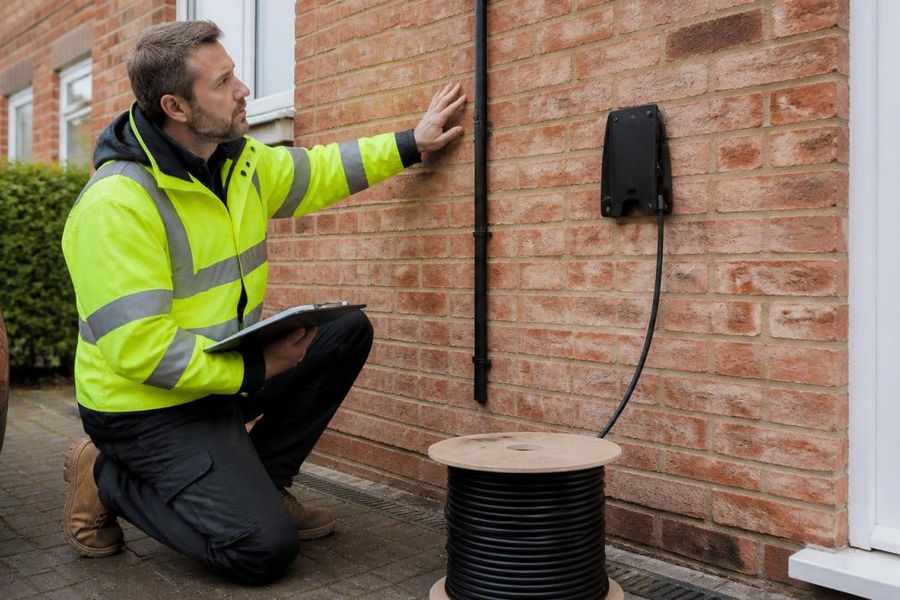
Cable route planning is deciding the physical path from consumer unit to charging point, and building in spare capacity along it. This is where future proofing is cheapest: conduit and a spare draw cord cost little during the first install and save a fortune later.
The future-proofing checklist
A joined-up checklist covers the decisions that are hard to reverse later:
Conduit size. Specify conduit large enough for a second cable, not just the one being installed today. A 25mm conduit is a common minimum for a single 6mm² or 10mm² armoured cable; going up a size costs little now and avoids a re-run later.
Draw cord. Leave a draw cord in every conduit run so a second cable can be pulled through without excavation.
Spare ways. Ask for at least one spare way in the consumer unit beyond the charger's own protective device, so a second charger or a battery inverter can be added without a unit change.
Isolation. Fit a lockable isolator local to the charging point so the unit can be safely isolated for maintenance without walking back to the consumer unit.
Second-charger branch point. Note where a future connection point could branch off, ideally where the route passes a garage, side return or second parking space.
Cable route reach. Choose a route that reaches both the driveway and any garage or side return, so a future charger can serve either.
Voltage drop. Keep runs as short as practical; long runs need larger conductors to keep voltage drop within limits, which is cheaper to plan now than to correct later.
Key Takeaway The cheapest future-proofing is the work you do while the walls are open: one size up on conduit, a draw cord, a spare way and a documented route. Everything else can wait.
Adapting the route to your parking situation
The right route depends on where you park. A detached house with a garage on the driveway can often run a short armoured cable from the consumer unit to the garage and site the charger there. A terraced house with on-street or shared parking may need a longer run to a front wall or a freestanding post, and the route should avoid crossing a neighbour's boundary or a public footpath.
If your property has particular quirks, our guide to EV charger installation for older homes goes deeper into the specific challenges and solutions.
The article sets out the future-proofing measures worth building in while the walls are open.
Item | Recommendation | Why it matters |
Conduit size | 25mm common minimum for a single 6mm² or 10mm² cable | Large enough for a second cable |
Draw cord | Leave one in every conduit run | Second cable pulled without excavation |
Spare ways | At least one beyond the charger's protective device | Second charger or battery inverter later |
Isolation | Lockable isolator local to the charging point | Safe isolation for maintenance |
Second-charger branch point | Where route passes garage, side return or second space | Future connection point identified |
Cable route reach | Reaches driveway and any garage or side return | Future charger can serve either |
Voltage drop | Keep runs as short as practical | Long runs need larger conductors |
Adding a Second Home EV Charger Later
Adding a second home EV charger is usually a load management question, not a wiring one, provided the first install left capacity.
The planning decision happens now: tell your installer a second point is likely. They can size the supply, leave a spare way and route conduit accordingly. Retrofitting that later means reopening finished walls and paying for a return visit.
Best for: two-car households and anyone expecting a second EV within a few years. Skip if: you are certain one vehicle is the long-term plan and supply headroom is tight.
Smart Charging, Load Management and Energy Tariffs
Smart charging is controlling when and how fast the car charges, so it uses cheap off-peak electricity and never overloads the house. Combined with a time-of-use tariff, it can reduce running costs.
Load management sits underneath this: the charger monitors whole-home demand and reduces charging power when the oven, shower or heat pump are running. That is often the difference between a standard install and an expensive supply upgrade.
To understand the mechanics, read our practical guide to dynamic load balancing for EV charging, and if you are weighing tariffs, see our comparison of the best off-peak electricity tariffs for EV owners.
Getting a Fixed-Price Quote for Your Installation
A fixed-price quote should state the charger, all materials, labour, VAT and any groundwork, with no conditional extras buried in the small print. Ask what is included and, more importantly, what is not.
The variables that move a quote are cable run length, consumer unit condition, earthing, and whether load management or an upgrade is needed. Our article on how to get a fixed price EV charger installation quote explains what is included, site survey requirements and grant eligibility.
At Yorks Ev, our standard supply and installation package covers all materials, labour and VAT, installations are completed within 14 days, and there is no travelling charge across North, South, East and West Yorkshire. When you are ready, you can get a quote for your property.
Future proofing is really a set of small decisions made once: spare conduit, honest capacity figures, a load-managed charger and a route that reaches a second parking space.
Yorks Ev is a family-run team of highly qualified, time-served electricians installing domestic chargers across Yorkshire, with fixed-price packages and installations completed within 14 days. Get started with Yorks Ev and charge at home affordably, reliably and without the guesswork.
Frequently Asked Questions
How can I future-proof my home for an electric vehicle charger?
Start by assessing your consumer unit capacity and asking an installer to run a dedicated circuit with spare capacity for a second charger. Plan a cable route that allows for extra conduit, and choose a smart charger that supports load management. These steps mean you can add another charging point later without major rewiring, keeping costs down and disruption minimal.
What electrical capacity do I need for a home EV charger?
A typical home EV charger runs on a dedicated 32-amp circuit, which needs a 7.4kW supply. Your consumer unit must have enough spare capacity to handle this alongside your existing appliances. An installer will carry out a load assessment to confirm whether your current supply can cope or whether an upgrade is needed before installation.
Can an older property support a home EV charger?
Many older properties can support an EV charger, but the consumer unit and wiring often need attention first. If your fuse board is outdated or your supply is limited, an electrician may recommend an upgrade. A full assessment will identify what is needed, and some older homes may need a new consumer unit or a supply upgrade to safely add a dedicated charging point.
Can I add a second EV charger to my home later?
Yes, if you plan for it during the first installation. Ask your installer to fit a consumer unit with spare ways and to run cabling that can accommodate a second circuit. Load management can then share the available power between two chargers. Planning ahead avoids the cost and disruption of rewiring when a second vehicle arrives.
Should I install EV charger cabling before I buy an electric car?
Installing cabling early can be sensible if you are renovating or having other electrical work done. It allows you to plan the cable route and capacity without rushing. However, the charger itself should be fitted by a qualified electrician once you know your vehicle and charging needs. Discuss timing with your installer to avoid unnecessary work.
What should I ask an installer about future EV charging needs?
Ask about spare capacity in the consumer unit, whether the cable route allows for a second charger, and what load management options are available. Confirm the installer is qualified and experienced with EV charging, and request a fixed-price quote that covers materials, labour and VAT. Also ask about smart charging features and how they work with your energy tariff.

Comments